Showing posts with label Capitalism. Show all posts

Tuesday, 19 March 2013

Animal Farm re-capitalised

In seeking criteria by which to judge the quality of literary work, that of inspiring homage or being repeatedly adapted or reworked seems to be a robust choice.  Thomas More's Utopia must be one of the most enduring and popular of such templates, having generated not only countless refashionings but entire genres, sub-genres and a political philosophy.  Animal Farm has similarly wound itself snugly around the cultural cortex, and has completed the related challenge of bequeathing phrases and ideas to everyday use.  Under the enduringly interesting Dedalus banner, Nicholas Bradbury has bravely donned his literary wellies and revisited Orwell's anthropomorphic bucolic institution.

Market Farm revisits and updates this extraordinary fable  and (without straying far from the original style and schema) develops the story with sufficiently clever and well-crafted material to make this a highly readable, topical and - as we very belatedly interrogate the nature and effect of financial global systems - important novel.  The major addition in terms of the cast list is a group of sly, manipulative foxes, who introduce representative systems of value into the farm community, beginning with 'money' based on the value of stored physical objects, graduating to a system of ious and eventually weaving a complex web of trade in mortgages, rent and debts which, when it inevitably implodes, threatens a descent into chaos and disaster.  In other words, what we have here is derivatives, rather than derivative, writing, and jolly good and necessary it is, too.  In fact, the book could serve a secondary function as a primer to the financial world for the less enlightened, among whose number I certainly counted myself, although, thanks to Mr. Bradbury, I now feel somewhat less qualified for membership.

Many of the details with which Bradbury decorates his project are ingenious and delightful; there is a dark hint of chicken prostitution as that species is persuaded into battery-servitude and penury by the foxes' propaganda, the evocation of dogmatic faith in 'the market' as a mystical devotion to 'The Snout', (the manifestations of which only the priest-like foxes are capable of deciphering), and a brilliant representation of the vacuity of much Twitter communication as tiny pieces of information passed on by sparrows, a 'service' to which many animals rapidly become addicted.  I believe this is an example of what one of my particularly inspiring lectures at university called 'literalizing the metaphor'.  Bradbury also turns a fine phrase, as in this description of one layer of symbolic value, the 'dominos':

The swirling of the dominos, they were told, was the closest that could be achieved to making visible the mystery of the Invisible Snout.

and he handles his narrative engine well, building to a moving climax regarding the fate of 'The Freedom Tree'.

One can, of course, always quibble with this sort of broad satirical allegorizing; there is the disturbing implication, for example, that the masses (that's us) are all too easily hoodwinked and distracted by tawdry entertainments (beautifully presented here in the guise of puppet shows) from lunatic sleight-of-hand financial manoeuvrings.  This may, of course, be countered by the defence of being true, if regrettable, but I can see no excuse for the poor cover which, should the book go into well-deserved further runs around the paddock, could be significantly improved.  Perhaps the foxes could help.

Monday, 19 November 2012

Left writes

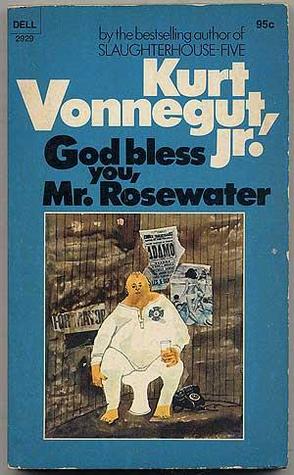
As awareness rises of how some well-known large corporations are organised to obviate the necessity of paying UK taxes, my mind has turned to writing about the global economic system, and in particular Kurt Vonnegut's God Bless you, Mr. Rosewater. This novel has an arresting opening line:
 A Sum of money is a leading character in this tale about people, just as a sum of honey might properly be a leading character in a tale about bees.
and concerns the attempts of one Eliot Rosewater to use his massive inherited fortune to perform public good works and improve the lot of the disenfranchised and unfortunate, a campaign to which his family responds by attempting to declare him legally insane. As with all Vonnegut's work, much of which is concerned with questions of economic and social equality, this broad satirical canvas is decirated with brush-strokes of irony which undermine any attempt to see the work as a simple declaration or manifesto, but there is some very astute writing about capitalism, especially - in the context of tax behaviour, in this well-known passage, in which Eliot's father is attempting to fathom his son's perspective: 

'"You mean shame about not knowing where the Money River is?"

"The what?"

"The Money River, where the wealth of the nation flows. We were born on the banks of it - and so were most of the mediocre people we grew up with, went to private schools with, sailed and played tennis with. We can slurp from that mighty river to our hearts' content. And we even take slurping lessons, so we can slurp more efficiently."

"Slurping lessons?"

"From lawyers! From tax consultants! From customers' men! We're born close enough to the river to drown ourselves and the next ten generations in wealth, simply using dippers and buckets. But we still hire the experts to teach us the use of aqueducts, dams, reservoirs, siphons, bucket brigades, and the Archimedes' screw. And our teachers in turn become rich, and their children become buyers of lessons in slurping."'

"I wasn't aware that I slurped."

This is Vonnegut at his best in terms of dialogue, imagery and humour, and the book is one to which I return frequently.

In the same vein, my dear wife kindly alerted me to a new children's graphic novel from an American labour organisation - Union Communication Services, inc. - which explains the violent circumstances under which the classic protest song 'Which Side are you on?' was penned.

In the interests of proper balance and objectivity, I will of course be posting a marginally slightly less left-wing article tomorrow.