Saturday, 2 November 2013

Paws for thought

The feline creature who previously graced this blog has left us mourning her passing, having attained the upper limits of cat longevity and brought us untold pleasure and invaluable companionship in doing so.  Following but by no means replacing Sally have come two new household deities. Splodge, 10 years old, is a handsome but frankly curmudgeonly rescue cat who is (literally) a poster boy for the Cat Protection League and who can turn (because, we fondly believe, of a challenging life including a period as a stray, not to mention arthritis in both forelegs, but, our more cynical selves suspect, possibly due to innate orneriness) from affectionate to violent behaviour in an instant.  Bramble, who is nearly new, is a kind of furry junior whirlwind, whose speed, excitability and curiosity send her ricocheting around the house in a bewildering blur of calico fur.  She has also recently and precociously taken to charades, as illustrated here. 

This was a particularly cunning selection on her part, because she obviously knew I would immediately plump for back cat-alogue and then Grimm's Furry Tails, whereas she had in mind the much more ingenious Our Mutual Fur-End.  You should see her do films.

Saturday, 21 September 2013

Things ain't what they used to be

I have a fondness for literary movements - be they critical or creative - as a kind of book world equivalent to football teams.  I want to see gangs of adherents to rival schools, eyeing each nervously across the floor of The British Library, vicious metaphors and sharpened similes waiting to be launched with ruthless accuracy, with the Cultural Materialists chanting:

'You're a bourgeois product of the class dynamic'

and the Deconstructionists replying, a little smugly:

'Hah! That statement negates its own attempt at meaning'.

There could be scarves, t-shirts, and a whole range of associated paraphernalia; I think, in fact, this could be my route to entrepreneurial glory.

The point is, I was recently expanding my meagre knowledge about the Oulipo movement (from Ouvroir de littérature potentielle; or workshop of possible literature); that merry band of (originally) French pranksters who imposed a range of unusual rules and restrictions on their writing, in order to bother the envelope of form a bit and see what emerged;  (that was a rough distillation of a few slightly more technical explanations).  Perhaps the best-known example is Georges Perec's  La disparition; a novel written without the benefit of a single letter 'e', and translated into English (by Gilbert Adair) likewise, as A Void.

One of Oulipo's recipes for making poetry was to start with an existing piece of verse, select a dictionary and substitute the major nouns in the original piece with those seven nouns along from them in said lexicon. This technique is called, with insouciant Gallic mysticism, N+7 (or, S+7 for 'substantive').  Using this simple formula, you can create brand new poetry in the comfort of your own garret (no glue or nails required).  Here's one I prepared earlier; I used Collins Concise Dictionary Plus, and took the liberty of modifying one verb to agree with the respective arriving noun. The result, I am obliged by truth to declare, is less elegant but much more hilarious than the original first stanza of Ode to Autumn.


Seatbelt of mistress and mellow frump,  
Close botany-frigate-bird of the maturing sundae;       
Conspiring with him how to load and bless       
With fruit salad the vino that round the theatre-ecclesiasticism runs;          
To bend with applicator the moss'd cotter-tree-lines
And fill all fruit-machines with ripple-marks to the coriander; 
To swell the governor, and plump the headboard shelters     
With a sweet ketone; to set budding more,        
And still more, later flue-pipes for the beef burgers,     
Until they think warm daydreams will never cease
For summer time has o'erbrimm'd their clammy cellphones.


Do please Comment or Facebook with your own; hey! we can build an anthology.


Monday, 26 August 2013

Leaves in the lines

Despite being designed, conceived and manufactured in Malta, I have a profound physical aversion to extreme heat.  By 'extreme' I mean, of course, anything over 15°c, so to say this Summer has been a challenge is an understatement of subterranean profundity.  I am reminded, in literary terms, of J.G. Ballard's The Burning World and that sequence in Stephen Donaldson's Thomas Covenant cycle where The Despiser has hacked into the planetary weather system so that each season is exaggerated to acquire deadly characteristics.  It is, therefore, with undignified eagerness that I have embraced each slightly cooler day, and am panting for Autumn to begin in earnest.  One of my ambitions this year is to read Louis MacNeice's Autumn Journal, which is one of the many yawning gaps in my literary CV.  A few years ago, giddy with the excitement of having purchased an Acme © Home Poetry Kit, I lobbed a lump of Autumnal words into the Sonnet stencil, cranked the attractively-bright plastic starting-handle and produced the following.  I sincerely hope MacNeices's effort is better.


OWED TO AUTUMN

The sunlight is soft with hospitable mystery;
In August it scorched us, expected and bland.
The pavements are crunchy with Natural History,
Where trees are dismissing their leaves out of hand.
It’s scruffy and vague, this shaggy brown season
Each morning arrives with a mist that depletes
All edges and borders – it was for good reason
That autumn inspired some reasonable Keats.
White winter is death, and all of us harbour
Suspicions of picture-book summers and springs,
A frisson of something amiss in the arbour
Is what this benevolent avalanche brings.
So wrap up in autumn, and heap praise upon it,
Season of almost compulsory sonnet.

Monday, 12 August 2013

Bloggin' the Nog

If all the biographies I have ever read were vertically stacked atop each other, the resulting structure would be far from an impediment to even very low-flying aircraft, or, for that matter, most wasps. This lack of engagement with the genre may be to do with my Reality allergy, or may be the result of a more amorphous blend of aesthetic and intellectual proclivities.  I'm hoping it's the latter. Whatever the reason, I was recently reminded of a book of this class which I had not only read but which also gave me an enormous amount of pleasure, namely Seeing Things, the autobiography of the remarkable Oliver Postgate.

Along with legions of others of all ages, I had been charmed, beguiled and not infrequently disturbed by Postgate's (and his partner Peter Firmin's) menagerie of whistling, knitted aliens, soporific talking cats and, of course, their own characteristic interpretation of Norse history and legend, namely Noggin and the Nogs   Knowing nothing about Postgate the person, the biography was a gradual, warming affirmation of a sensitive, ingenious human being who bore vicissitude with courageous stoicism, espoused all that is admirable in humanity and whose creative energies, sometimes diverted by restrained resources and facilities into wondrously ingenious channels, refused to be stifled.

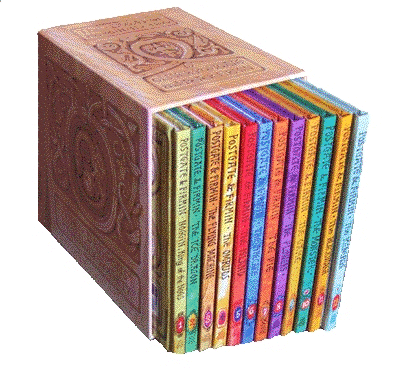
I was reminded of this book last week as I worked (never was a verb less appropriate) my way through a delicious boxed set of Noggin the Nog books.  These 12 books, beautifully produced and illustrated, are charming fables in which characters and themes recur in a variety of 'Nordic' settings and themes, from The Hot Water Valley to the mechanical Island, from prejudice and fear to the misuse of technology.  There is a great deal of pleasure to be had in Postgate's putting the Vikings through a blender set on 'whimsy' (the foremost warrior, for example, Thor Nogson, is often strongly drawn towards discretion rather than valour), but there are also lovely jokes:

'With a crash and a slop like barrels of water breaking on the roof, the barrels of water on the roof broke asunder'

wonderful imaginary proper nouns, such as Troldeskow and Graculus, and delightful variations on well-known stories and legends.


Without over-egging the Nog, I can't help but think that Olaf, the ingenious court inventor who is constantly threatening the end of civilisation through the development of unpredictable machines, is Postgate wryly observing his own insatiable desire to create brilliant television out of two pipe-cleaners and a reel of Sellotape, while the ever-present Nogbad the Bad, lurking like an unpleasant odour in each tale, is a reminder that evil is never far from even the most innocent-seeming scenario (or even interwoven into it - Nogbad is, after all, Noggin's uncle).  To end on a jollier note, however, why not visit the lovely Dragons' Friendly Society website, and order the books.

Monday, 22 July 2013

Paradise glossed

It is a consolation to me that the lateness with which I came to Paradise Lost has been matched by the fervency of my recommendation of it since that time when, a mere few years ago, I walked alongside our first parents out of Eden.  I am now not unlike the Ancient Mariner, with my short grey stubble and smudged spectacle lenses, accosting guests en route to weddings, bar mitzvahs and other formal occasions and quothing 'There is a jolly long poem', and then driveling on about Milton's neologisms, his technical skill and my delighted surprise in encountering an explicit description of sex between angels.

I was, therefore, delighted to be introduced to a booklet in a series called Connell Guides, which offers many interesting insights into how the poem works and how Milton's life and beliefs are reflected in the subject matter, style and tone.  Unlike the undoubtedly useful but somewhat brash tourist guides that are the standard revision guides to Great Works of Literature, my Connell is a chic, urbane, well-dressed and highly articulate escort - more like being conducted around an unfamiliar city by a bi-lingual native as opposed to a slightly inebriated package holiday courier.

Caroline Moore is that person in this case, viewing the poem from a number of perspectives, posed as fundamental questions, many of which are archetypal responses to the poem, e.g.


  • Is Milton’s handling of Satan flawed?
  • What makes Eve finally choose wrong?
  • Is Eve inferior to Adam?
  • Why have so many critics misread Paradise Lost?
  • How does Paradise Lost fit into the tradition of epic poetry?

Moore's responses are intelligent, perceptive and full of excellent close reading, often teasing out nuances of word or phrase which demonstrate the subtlety and wit of Milton's writing. Moore expertly defuses much of the bafflement and inhibition that can surround a work like, this, the structure and scope of which are so unfamiliar to modern sensibilities. Accompanying the main text are shaded sections offering information on, among other aspects, the historical, literary and personal background to the poem, and the package is further graced by a number of very well-reproduced paintings, engravings and drawings related to this inexhaustibly inspiring story.  Your Connell also comes equipped with further reading and author chronology, as standard.


If, like that slightly younger version of me, you have yet to clamber into Milton's Garden, get thee to a copy immediately, and then buy the Connell's guide.

Wednesday, 10 July 2013

Thirkells within Thirkells

There is a strong and enigmatic appeal to the human mind in the paradoxical and the self-referential.  From Russian dolls, through novels within novels, to the more mind-endangering philosophical instances such as whether the set of non-self-membered sets belongs to itself,** we are drawn towards a range of cultural and mental phenomena that, as it were, double-back on themselves.

I am probably not a bear of sufficiently large brain to speculate usefully on the reasons for this strange attraction, but, if taxed, I might suggest it has something to do with the aesthetic and structural appeal of reflection and repetition, and if further pressed and supplied with spirituous liquor of sufficient strength and likewise volume, I may become pretentious enough to speculate upon how the nature of consciousness and the structure of the brain are linked to the matter.  I don't think I'd believe myself in the morning, however.

The phenomenon was recently re-presented to my attention by reading Angela Thirkell's High Rising (see my blog review). That's three hyperlinks in a row - is there not a large, cuddly toy now?  In this charming amuse-bouche of a novel, there is a great deal of writing going on, including serious historical biography, the main character's own light fiction (which sounds remarkably similar to the book we're reading) and her son's sudden outpouring of accidentally hilarious poetry, viz:

By marsh and mallow
Fern and glen.
By marsh and mallow,
Went they then.

By marsh and mallow

The moorhen
By marsh and mallow
Went she then.

By marsh and mallow

When, ah then,
A hunter sallow
Shot that moorhen.

By marsh and mallow

Fern and glen.
By marsh and mallow,
Ne'er again.

Writing in writing is used in many ways, of course, from such satire of precious teenage bathos to highly erudite pastiche, as in AS Byatt's Possession, wherein we can joyfully play 'spot the poet' as we skip through the pages.  One example that has tireless appeal for me is Kurt Vonnegut's hapless ego Kilgore Trout, the hack science-fiction writer who shuffles, dishevelled in appearance and fortune, through many of the late, great author's novels.  Vonnegut presents short summaries of Trout's writing to great comic and emotional effect, partly to satirise science fiction and people's attitudes to science fiction, and also undermining the whole notion that writing needs to have 'meaning' or 'secrets' picked out of it like nits from a scalp.  As a former marginalised 'science-fiction writer' himself, Vonnegut is also taking a swipe at himself, in a clear case of having your cake, eating it, then deriding the whole notion of cake-eating as a legitimate endeavour.  Vonnegut's terse summaries of Trout's work are always going to be more entertaining than the actual works would have been, had they really existed, which is part of the whole, very Vonnegutian, multi-layered joke:

'As for the story itself, it was entitled "The Dancing Fool." Like so many Trout stories, it was about a tragic failure to communicate. Here was the plot: A flying saucer creature named Zog arrived on Earth to explain how wars could be prevented and how cancer could be cured. He brought the information from Margo, a planet where the natives conversed by means of farts and tap dancing. Zog landed at night in Connecticut. He had no sooner touched down than he saw a house on fire. He rushed into the house, farting and tap dancing, warning the people about the terrible danger they were in. The head of the house brained Zog with a golfclub'.


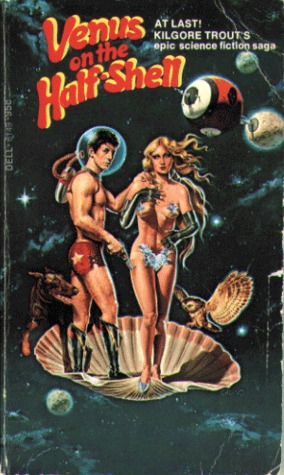
This particular stream of self-reference took an even wilder course when a real science-fiction writer produced a full-length novel by Kilgore Trout, these being Philip José Farmer and Venus on the Half-Shell, respectively.

I shall leave you to hunt down your own second-hand copy of the only surviving Trout novel, and I haven't even mentioned At Swim-Two-Birds.


**if it doesn't, then it must, and vice-versa; this realisation apparently gave Bertrand Russell quite a turn.

Wednesday, 19 June 2013

An exceeding amount of poetry

Inspiration can be a phenomenon which is slightly short on details.  When, moved by reading Mary Hamer's excellent fictional rendition of Kipling's and his sister's life (Kipling & Trix), to read the man's poetry, I was unprepared for the sheer size of the task.  A few days ago, the equally excellent Herts Library service procured for me Kyle Cathie's edition of the complete verse, which proved to comprise over 600 pages of closely-set rhyming stuff.  Where did people from previous generations derive their literary energy, and what happened to its source? Was there a secret River of Prolificity, which has long since been stifled by some kind of cultural alluvium? Nothing daunted, I levered myself into my poetry climbing-boots, whittled a fresh ballad-stick and set off for the foothills.

The journey begins with - to further strain the metaphor to creaking-point - some outlying scree and minor ascents, which are of largely academic interest.  The Departmental Ditties are technically highly proficient light verse, documenting and satirising the British and (to some extent) native cultures and behaviours that defined the British Indian Imperial period.  Many of the themes that Kipling went on to elaborate and become notorious for are present here, such as the  blasé cynicism regarding the hardships of the colonial life (and especially the climate) among those who had not experienced it; the corruption and bribery that oiled the imperial wheels and the often torrid love affairs that distracted The White Men from their Burden.  The poem that stood out for me, like a significant preliminary peak, was The Last Department, in which Kipling brilliantly diverts the language and culture of British India to describe the inevitability and nature of death. The link will disclose the whole poem, but here's a taste:


When leave, long overdue, none can deny;
When idleness of all Eternity
  Becomes our furlough, and the marigold
Our thriftless, bullion-minting Treasury

Transferred to the Eternal Settlement,
Each in his strait, wood-scantled office pent,
  No longer Brown reverses Smith's appeals,
Or Jones records his Minute of Dissent.

And One, long since a pillar of the Court,
As mud between the beams thereof is wrought;
  And One who wrote on phosphates for the crops
Is subject-matter of his own Report.

This is macabre, satirical verse at its best, and well worth engraving above your own office cubicle.

Look out for further dispatches from Mount Kipling, as I inch towards the summit, without the benefit of oxygen.  In the meantime, those reasonably adjacent to the Borough of Sutton near London may wish to attend a talk being given by Mary and the acclaimed literary biographer Andrew Lycett, at Sutton Central Library on the evening of July 3.  Andrew's biography of Kipling was rapturously reviewed, and won the accolade of being selected as a TLS International Book of the Year by Terry Eagleton. It should be fascinating to hear the fictional and biographical approaches compared.