There is a strong and enigmatic appeal to the human mind in the paradoxical and the self-referential. From Russian dolls, through novels within novels, to the more mind-endangering philosophical instances such as whether the set of non-self-membered sets belongs to itself,** we are drawn towards a range of cultural and mental phenomena that, as it were, double-back on themselves.
I am probably not a bear of sufficiently large brain to speculate usefully on the reasons for this strange attraction, but, if taxed, I might suggest it has something to do with the aesthetic and structural appeal of reflection and repetition, and if further pressed and supplied with spirituous liquor of sufficient strength and likewise volume, I may become pretentious enough to speculate upon how the nature of consciousness and the structure of the brain are linked to the matter. I don't think I'd believe myself in the morning, however.
The phenomenon was recently re-presented to my attention by reading Angela Thirkell's High Rising (see my blog review). That's three hyperlinks in a row - is there not a large, cuddly toy now? In this charming amuse-bouche of a novel, there is a great deal of writing going on, including serious historical biography, the main character's own light fiction (which sounds remarkably similar to the book we're reading) and her son's sudden outpouring of accidentally hilarious poetry, viz:
By marsh and mallow
Fern and glen.
By marsh and mallow,
Went they then.
By marsh and mallow
The moorhen
By marsh and mallow
Went she then.
By marsh and mallow
When, ah then,
A hunter sallow
Shot that moorhen.
By marsh and mallow
Fern and glen.
By marsh and mallow,
Ne'er again.
Writing in writing is used in many ways, of course, from such satire of precious teenage bathos to highly erudite pastiche, as in AS Byatt's Possession, wherein we can joyfully play 'spot the poet' as we skip through the pages. One example that has tireless appeal for me is Kurt Vonnegut's hapless ego Kilgore Trout, the hack science-fiction writer who shuffles, dishevelled in appearance and fortune, through many of the late, great author's novels. Vonnegut presents short summaries of Trout's writing to great comic and emotional effect, partly to satirise science fiction and people's attitudes to science fiction, and also undermining the whole notion that writing needs to have 'meaning' or 'secrets' picked out of it like nits from a scalp. As a former marginalised 'science-fiction writer' himself, Vonnegut is also taking a swipe at himself, in a clear case of having your cake, eating it, then deriding the whole notion of cake-eating as a legitimate endeavour. Vonnegut's terse summaries of Trout's work are always going to be more entertaining than the actual works would have been, had they really existed, which is part of the whole, very Vonnegutian, multi-layered joke:
'As for the story itself, it was entitled "The Dancing Fool." Like so many Trout stories, it was about a tragic failure to communicate. Here was the plot: A flying saucer creature named Zog arrived on Earth to explain how wars could be prevented and how cancer could be cured. He brought the information from Margo, a planet where the natives conversed by means of farts and tap dancing. Zog landed at night in Connecticut. He had no sooner touched down than he saw a house on fire. He rushed into the house, farting and tap dancing, warning the people about the terrible danger they were in. The head of the house brained Zog with a golfclub'.
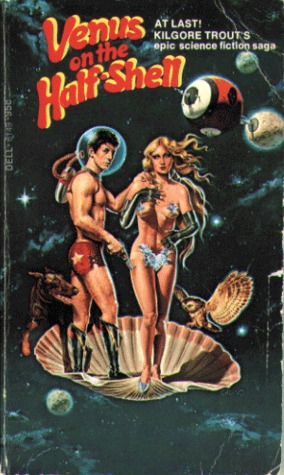
This particular stream of self-reference took an even wilder course when a real science-fiction writer produced a full-length novel by Kilgore Trout, these being Philip José Farmer and Venus on the Half-Shell, respectively.
I shall leave you to hunt down your own second-hand copy of the only surviving Trout novel, and I haven't even mentioned At Swim-Two-Birds.
**if it doesn't, then it must, and vice-versa; this realisation apparently gave Bertrand Russell quite a turn.
Showing posts with label Kurt Vonnegut. Show all posts
Wednesday, 10 July 2013
Wednesday, 10 April 2013
Literary devices
I do hope that, like me and some members of my household (my wife, certainly, but I'm not sure about the cat) you enjoy the snippets of book gossip, news and brief discursive observations that comprise The Week in Books in the Saturday Guardian. For those less familiar, this feature can be located in section 17(b) of the paper, the Review. Last week's Week included an amusing and significant piece by John Dugdale on the mobile 'phone. This was prompted by the device celebrating its 40th birthday (I know - how does it retain that youthful blush?) and examined the relative absence of the mobile (and 'the texture of urban life in general in the digital era') from contemporary literary fiction, together with the problems that including these elements might cause for narrative and plot.
This reminded me of the issues often raised by Kurt Vonnegut regarding the relationship between fiction, technology and literary respectability. Vonnegut was writing from what I believe cultural critics like to call a contested space between the (perceived) nations of popular, literary and science fiction. Vonnegut had an inimitable way of making wildly and knowingly generalised observations about complex situations that still had penetration and trenchancy. In an essay on Science Fiction for example, he observes, in this kind of assumed, ironic faux homespun style that: The feeling persists that no one can simultaneously be a respectable writer and understand how a refrigerator works, just as no gentleman wears a brown suit in the city.
Does this attitude persist? Although I am far from being the best-versed person I know in contemporary literary fiction, I have gathered a definite impression that heavyweight writers are far more willing to explicitly tackle biological and genetic aspects of science and technology than electronic, mechanical or other varieties. I would be only too happy to wither under a volley of counter-examples, if you'd like to use the comment feature, or e-mail me at davidlbirkett@hotmail.comm and allow me to post your remarks as a comment. To be honest, I am shamelessly craving more blog comments at the moment, as there's a terrible draught whistling through that space. These old laptops, ay? Still, they have character.
In the meantime, I have let the idea of mobile 'phones run like a largely-crazed ferret through the world of literary classics, and come up with the following:
Mast of the Mohicans
Text of the d'Urbervilles
Appsolute Beginners
Samsung Agonistes
Lord of the Ringtones
Sex and the Signal Girl
etc.....
This reminded me of the issues often raised by Kurt Vonnegut regarding the relationship between fiction, technology and literary respectability. Vonnegut was writing from what I believe cultural critics like to call a contested space between the (perceived) nations of popular, literary and science fiction. Vonnegut had an inimitable way of making wildly and knowingly generalised observations about complex situations that still had penetration and trenchancy. In an essay on Science Fiction for example, he observes, in this kind of assumed, ironic faux homespun style that: The feeling persists that no one can simultaneously be a respectable writer and understand how a refrigerator works, just as no gentleman wears a brown suit in the city.
Does this attitude persist? Although I am far from being the best-versed person I know in contemporary literary fiction, I have gathered a definite impression that heavyweight writers are far more willing to explicitly tackle biological and genetic aspects of science and technology than electronic, mechanical or other varieties. I would be only too happy to wither under a volley of counter-examples, if you'd like to use the comment feature, or e-mail me at davidlbirkett@hotmail.comm and allow me to post your remarks as a comment. To be honest, I am shamelessly craving more blog comments at the moment, as there's a terrible draught whistling through that space. These old laptops, ay? Still, they have character.
In the meantime, I have let the idea of mobile 'phones run like a largely-crazed ferret through the world of literary classics, and come up with the following:
Mast of the Mohicans
Text of the d'Urbervilles
Appsolute Beginners
Samsung Agonistes
Lord of the Ringtones
Sex and the Signal Girl
etc.....
Monday, 25 March 2013
Choosing my religion
In any case, revisiting Earth, Mars, Mercury and Titan in this novel, as is usual with Vonnegut, combined the pleasure of cavorting around in his playground of ideas and jokes and purring with pleasure at his style:
And yawning under all those bowls was the upturned mouth of the biggest bowl of them all...a regular Beelzebub of a bowl, bone dry and insatiable...waiting, waiting, waiting for that first sweet drop.
with the renewed realisation that very few books were going to produce such a rich reading experience. I'm grateful for Vonnegut's having been relatively prolific, and thus leaving scope for a long and varied cycle of re-reading.
As do many of his books, Sirens features a fabricated religion, The Church of God the Utterly Indifferent, whose central credo is that we are all the 'victims of a series of accidents' and which vehemently denies the existence of any benevolent divine working in the universe. For Vonnegut, fictitious religion was a tautology, and his repeated coinings of faiths, such as The Church of Jesus Christ the Kidnapped and Bokononism, embody this view. The latter is Vonnegut's most involved and detailed religious system and, typically, has at its first statement that what follows is a highly systematic series of untruths. Although these created theologies have specific satirical and structural roles in the various books, they are of course reiterating Vonnegut's belief that all religion is a fiction but that it's important to choose the most effective one nonetheless. This stance is related to his also oft-repeated observation that we all depend on constructing narratives - which may have serious arguments with reality - to maintain our mental stability. The writer of this blog does not necessarily endorse either of these views, although he is (as you may have gathered) capable of being infinitely charmed by Vonnegut's various expressions of them.
It is interesting to note that, among the many cultural references inspired by Vonnegut, Bokononism (which is an integral part of the novel Cat's Cradle) features fairly heavily, although the best-known homage is probably Al Stewart's song, The Sirens of Titan, which very elegantly converts the novel into a modern popular beat composition.
So it goes.
Sunday, 10 February 2013
Words' worth
It is with understandable frequency that discussions nowadays develop between friends and acquaintances and myself about the economics of the book industry. To name the two most obvious stimuli to these interchanges: the emergence of e-books has thrown a very inquisitive spanner into the works of traditional pricing models, and the dominance of on-line retailing, combined with aggressive price promotion in general, has contributed to the demise of many physical bookshops. I take a wistful pleasure in reminding or informing those of my acquaintance who have been less intimate with the book trade, that there once was a land in which almost all books were obliged to be, by statute, sold at the recommended retail price and that this land was Britain between 1900 and 1997. One of the arguments advanced by advocates of the Net Book Agreement, especially before the Internet had been handed out so widely, was that there was a social and cultural benefit to bookshops existing in communities and that, deprived of an easy and accessible route to literature, entire towns and villages would experience a decay in sensibility which would lead to a gradual dissolution of shared values, lower intellectual capacities, gangs of semi-literate feral children roaming the streets and eventually X-Factor and Britain's Got Talent.
This argument - that books are important, or even essential to society - has reasserted itself in the apparently blatant contradiction that e-books are subject to VAT whereas their fleshier counterparts skip gaily around the faery circle of exemption. It would be interesting to construct a justification for this anomaly. I would suggest arguing that paper books are more vital to the social fabric because - through their presence on bookshelves - they provide vital clues to the character, culture and psychology of those people into whose homes one is for the first time setting foot. Without these signposts, relationships, would be more difficult to build, networking would suffer and the impact on business could be catastrophic. On the other hand, immediately detecting a few yards of decent literary fiction, a sprinkling of classics, some poetry and recent credible works of popular science, would signal that their owners are well-rounded, intelligent and sensitive people, and enable one to circumvent much of the usual ice-breaking and cultural probing that is required to reach this conclusion. The time thus saved, I have estimated by use of Squibble's Divergent Oscillating algorithm, would enable two major hospitals or four and a half international manufacturing contracts to be constructed.
There is also, of course, the counter-argument that reading is simply a form of entertainment which has been varnished with an illegitimate lustre of significance and worth by an oppressive, elitist stratum of society that, while it rails against The Only way is Essex, actually owns all the boxed sets and watches them while pretending to be enjoying existential European films. I exaggerate this position a teeny bit for effect. This being the case, books should be treated, in terms of social status, tax and economics, as are Cd's, DVDs or their downloaded equivalents. The one remaining exception ought to be educational texts, for obvious reasons. We could then have enormous fun with readers claiming VAT rebates by filling in wildly complicated forms in an attempt to establish that, for example, reading Kafka's novels taught them that life is a puzzling and painful existential riddle, attempting to answer which only makes it more intractable. HMRC inspectors could then visit and interrogate the claimants to establish whether such works had, indeed, properly imparted such lessons to them, or whether they had only read the 'Meaning and Significance' sections in Coles' Notes.
I shall leave you with the words of the saintly Kurt Vonnegut on this subject, although you must run them through your own irony filters as you see fit:
'Do writers have a right to strike?'
I just can't help thinking what a real shake up it would give people if, all of a sudden, there were no new books, new plays, new histories, new poems...'
'And how proud would you be when people started dying like flies?' I demanded.
'They'd die more like mad dogs, I think--snarling & snapping at each other & biting their own tails.'
I turned to Castle the elder. 'Sir, how does a man die when he's deprived of the consolation of literature?.
'In one of two ways,' he said, 'petrescence of the heart or atrophy of the nervous system.'
'Neither one very pleasant, I expect.' I suggested.
'No,' said Castle the elder. 'For the love of God, both of you, please keep writing!'
This argument - that books are important, or even essential to society - has reasserted itself in the apparently blatant contradiction that e-books are subject to VAT whereas their fleshier counterparts skip gaily around the faery circle of exemption. It would be interesting to construct a justification for this anomaly. I would suggest arguing that paper books are more vital to the social fabric because - through their presence on bookshelves - they provide vital clues to the character, culture and psychology of those people into whose homes one is for the first time setting foot. Without these signposts, relationships, would be more difficult to build, networking would suffer and the impact on business could be catastrophic. On the other hand, immediately detecting a few yards of decent literary fiction, a sprinkling of classics, some poetry and recent credible works of popular science, would signal that their owners are well-rounded, intelligent and sensitive people, and enable one to circumvent much of the usual ice-breaking and cultural probing that is required to reach this conclusion. The time thus saved, I have estimated by use of Squibble's Divergent Oscillating algorithm, would enable two major hospitals or four and a half international manufacturing contracts to be constructed.
There is also, of course, the counter-argument that reading is simply a form of entertainment which has been varnished with an illegitimate lustre of significance and worth by an oppressive, elitist stratum of society that, while it rails against The Only way is Essex, actually owns all the boxed sets and watches them while pretending to be enjoying existential European films. I exaggerate this position a teeny bit for effect. This being the case, books should be treated, in terms of social status, tax and economics, as are Cd's, DVDs or their downloaded equivalents. The one remaining exception ought to be educational texts, for obvious reasons. We could then have enormous fun with readers claiming VAT rebates by filling in wildly complicated forms in an attempt to establish that, for example, reading Kafka's novels taught them that life is a puzzling and painful existential riddle, attempting to answer which only makes it more intractable. HMRC inspectors could then visit and interrogate the claimants to establish whether such works had, indeed, properly imparted such lessons to them, or whether they had only read the 'Meaning and Significance' sections in Coles' Notes.
I shall leave you with the words of the saintly Kurt Vonnegut on this subject, although you must run them through your own irony filters as you see fit:
'Do writers have a right to strike?'
I just can't help thinking what a real shake up it would give people if, all of a sudden, there were no new books, new plays, new histories, new poems...'
'And how proud would you be when people started dying like flies?' I demanded.
'They'd die more like mad dogs, I think--snarling & snapping at each other & biting their own tails.'
I turned to Castle the elder. 'Sir, how does a man die when he's deprived of the consolation of literature?.
'In one of two ways,' he said, 'petrescence of the heart or atrophy of the nervous system.'
'Neither one very pleasant, I expect.' I suggested.
'No,' said Castle the elder. 'For the love of God, both of you, please keep writing!'
Monday, 19 November 2012
Left writes
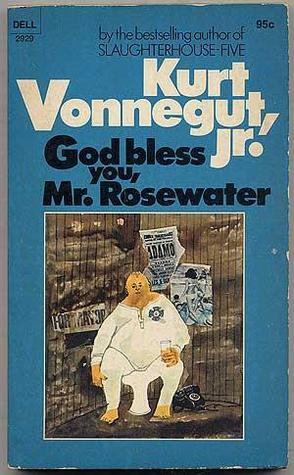
As awareness rises of how some well-known large corporations are organised to obviate the necessity of paying UK taxes, my mind has turned to writing about the global economic system, and in particular Kurt Vonnegut's God Bless you, Mr. Rosewater. This novel has an arresting opening line:
A Sum of money is a leading character in this tale about people, just as a sum of honey might properly be a leading character in a tale about bees.
and concerns the attempts of one Eliot Rosewater to use his massive inherited fortune to perform public good works and improve the lot of the disenfranchised and unfortunate, a campaign to which his family responds by attempting to declare him legally insane. As with all Vonnegut's work, much of which is concerned with questions of economic and social equality, this broad satirical canvas is decirated with brush-strokes of irony which undermine any attempt to see the work as a simple declaration or manifesto, but there is some very astute writing about capitalism, especially - in the context of tax behaviour, in this well-known passage, in which Eliot's father is attempting to fathom his son's perspective:
'"You mean shame about not knowing where the Money River is?"
"The what?"
"The Money River, where the wealth of the nation flows. We were born on the banks of it - and so were most of the mediocre people we grew up with, went to private schools with, sailed and played tennis with. We can slurp from that mighty river to our hearts' content. And we even take slurping lessons, so we can slurp more efficiently."
"Slurping lessons?"
"From lawyers! From tax consultants! From customers' men! We're born close enough to the river to drown ourselves and the next ten generations in wealth, simply using dippers and buckets. But we still hire the experts to teach us the use of aqueducts, dams, reservoirs, siphons, bucket brigades, and the Archimedes' screw. And our teachers in turn become rich, and their children become buyers of lessons in slurping."'
"I wasn't aware that I slurped."
This is Vonnegut at his best in terms of dialogue, imagery and humour, and the book is one to which I return frequently.
In the same vein, my dear wife kindly alerted me to a new children's graphic novel from an American labour organisation - Union Communication Services, inc. - which explains the violent circumstances under which the classic protest song 'Which Side are you on?' was penned.
In the interests of proper balance and objectivity, I will of course be posting a marginally slightly less left-wing article tomorrow.
Subscribe to:
Posts (Atom)