As the days grow shorter, so the shortlists lengthen. Having just been presented with the Specsavers National Book Awards (see my incisive socio-critical deconstruction of same here), publishers, wholesalers, bookshops and booksellers throughout the country are frantically coming to grips with the Costa finalists. The two most obviously newsworthy aspects of the Costa are the inclusion of Bring up the Bodies (they should simply rename all the fiction prizes 'The Hilary' and save time) and that of a brace of illustrated prose (see this blog post and marvel at how on the pulse is my digital finger (can fingers be anything other than digital?)). I'm sorry - I think I've been hopelessly seduced by nested brackets. The graphic works, interestingly, are divided between the Novel and Biography division, with Days of the Bagnold Summer and Dotter of her Father's Eyes respectively waving the flag for books with pictures, the former from a major traditional publishing house, the latter from a respected independent comics publisher.
Which, preamblingly, brings me to the peak of the prize-giving season, The Bad Sex Award, which has excited most comment over two exclusions, namely J.K. Rowling (no, not for Hairy Porter) and EL James. The list of non-excludees, together with the appropriate extracts, can be found in the link. I applaud the aims and sentiments of this award:
"to draw attention to the crude and often perfunctory use of redundant passages of sexual description in the modern novel – and to discourage it"
and have often found that perfectly reasonable novels are rendered unpalatable by such scenes, especially where a male author has created a female participant whose listed personal and physical attributes, along with the degree of unbearable ecstasy she is able to precipitate, smack of a rather grubby kind of wish-fulfilment rather than literary creation.

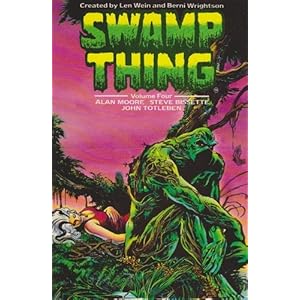
'But what' I hear you ask, with your typical perspicacity and intelligence, 'about the good sex?'. Perhaps bizarrely, one of my favourite descriptions of physical conjugation takes place within a graphic novel (can this get more intertwined?) and involves a human communing with a plant elemental in a kind of physical and mental union that allows them to share each other's consciousness and embrace the universe in a single vision. I speak of none other than a creature who has gurgled his way into these posts on a few previous occasions, the enigmatic Swamp Thing and his lover, Abby, who perform this union in volume 4 of the collected Saga of the Swamp Thing, by Alan Moore, when Abby (as you do) eats a particular plant that constitutes part of Swampie's physical form.
The writing in this scene, as is often the case with Moore, is high-flown and florid, but - taken in context - is entirely appropriate, and the passage is typical of the intelligence, wit and range of cultural and literary references that this writer brings to his work. The whole Saga is an incredible tour de force, embracing a dizzying range of subjects (vampires, misogyny, pollution, God and the afterlife, garden furniture), themes and perspectives, and makes the average Superbloke story seem like something scrawled in crayon by a very young child.
I'd love to hear your examples of good sex (fiction and poetry only, please).
Is there such a thing as a 'booksellers' book'? The title I keep coming across as a staff favourite in the retail environment is The Master and Margarita, and our bookshop in Welwyn Garden City (town slogan: 'Almost the first garden city') is no exception. Bulgakov's book has the appropriate blend of literary quality, knowing eccentricity, grand themes and black comedy to endear it to self-conscious literary types, who are not unknown behind bookshop counters. I came across, and was enthralled by the book relatively late in life, and was pleased to discover in the early pages that it had been referenced in another literary favourite, Alan Moore's Swamp Thing saga; mention of which there may already have been in this blog. Buy it immediately, need I add; Alan Moore is a self-proclaimed witch these days, and cauldrons ain't cheap. The book was reactivated in my memory today (my first day as a full-time (temporary (Christmas)) bookseller) when a customer ordered the graphic novel version published by Self-Made Hero.
We witnessed an advanced symptom of Christmas today - a wide outbreak of people carrying lists and looking anxious. Purchasing books in satisfying-looking heaps is the only reliable cure. We had a jolly day, and the till received plenty of exercise, in between our doughty crew attempting to extrude a large stock order of Fiction and Crime onto the shelves, a process which involved advanced book relocation skills, including the invasion of defenceless display tables and the attempts to reclassify books into less-populated sections (I've always thought of Patricia Cornwell as Mind, Body, Spirit, especially Body).
My own brief was to organise crime (there is such a thing as organised crime), a genre with which I have a strange relationship, in that I have always felt I ought to like it, but have never succeeded in doing so. I have close friends who regularly wave their current favourite detectives, police officers and private eyes seductively in front of me, but I always feel disappointed by the conventions of the genre. I thought Jo Nesbo would convert me, but about two thirds of the way through The Redeemer, there was a proliferation of sub-plots and twists that seemed like a literary Japanese Knotweed, and I lost patience as the book lost credibility for me. And what is it with these cynical, alcoholic or drug-addicted police officers who are inevitably dragging at least one failed marriage in their psychological wake? Is there a training course they're sent on? Do bright and capable police personnel who have clumsily failed to become addicted to anything, and whose marriage has somehow succeeded, find themselves bumping into a glass ceiling when it comes to promotion? 'Sorry, Sergeant Normal, but you're simply too psychologically well-balanced for this role. Take this large amount of crack and come back in a few months'. If I do happen to enjoy a book that might be claimed by the Crime mob (e.g. Miss Smilla's Feeling for Snow), I reclassify it as Literature. People have been doing this with Science Fiction for years.
Reading update: I'm about a quarter of the way through Kaddish for an Unborn Child, which means I've read about four sentences of it. It's still very good. Buy it when you pick up Swamp Thing.
It may not have escaped your attention, possessing as I feel sure you do a pair of finely-honed literary antennae (I can see them now, their delicate stems glowing in the limpid Autumn sunshine) that those sorts of books of which Alice approved - i.e. that contain pictures - are no longer excluded from serious consideration and respect. In fact, graphic novels, (or verbal comics?) especially those that deal with the world's most pressing social and political issues, are now considered an essential element in the output of most major literary houses (at least I assume it's most - I haven't done anything tedious like actually to check).
I feel particularly interested in this habilitation of the genre, as I witnessed its beginnings in the late 1980's from the perspective of one who read traditional superhero and fantasy literature stories when they were just plain comics, or at best 'quite long comics'. The genre experienced a benign upheaval as artists and writers like Frank Miller (The Dark Knight Returns) and Alan Moore (Watchmen and the infinitely superior Swamp Thing (no, honestly, I kid you not)) brought new sensibilities, subject matter and, to be frank, sheer ability and creative intelligence to a genre that barely recognised such things. Bliss was it in that dawn to be a fanboy (an affectionately derogatory term for an obsessive follower of tights-wearing super-types) as the media exploded into raptures about these works, and the literary establishment gradually ushered them away from the tradesmen's entrance. The creative fervour that produced this reaction seemed, however, to die down, only for less conspicuous but more insistent waves of resurgence and reinvention to continue the process, until today we have Persepolis and Palestine read without shame (or false covers) by the literati. Of course, there has for an age been excellent, thoughtful work in the panels and speech balloon category that didn't involve superheroes (Will Eisner, Love and Rockets, etc) but the people who knew about this stuff tended to be the same ones who read about The Mighty Wow Person and his arch-nemesis Zark the Dismal. It seems that a retrospective amnesty has been granted to these previous generations of 'serious' panel-based creators, which can only be a good thing.
On a recent birthday outing, my wife treated me to a basket-full of graphic stuff from the formidable Forbidden Planet shop in Shaftesbury Avenue. I derived almost as much pleasure from witnessing her culture shock in this emporium as I did from spending an unfeasible amount of time catching up on what was out there and selecting a few choice morsels. To leave with a couple of recommendations: among my favourite purchases were: The Color of Earth, by Kim Dong Hwa, the first part of a trilogy exploring a Korean girl's transition to womanhood and her relationship with her mother and Hilda and the Midnight Giant, by Luke Pearson. The first is an exquisite, frank and subtle piece of narrative art, the second an imaginative fable for most readerships, including adults who want a darned good excuse to read picture books again.
Enjoy.